Autism toilet training for caregivers: complete 2026 guide
Start here: our full guide to Toilet training and toileting delays.
Autism toilet training for caregivers is a step-by-step approach to bathroom practice with the aim of helping an autistic child use the toilet with less distress and more independence. In 2026, the starting point is not a fixed age or a deadline: it is your child’s comfort, health, communication and daily routine.
- Autism toilet training for caregivers starts with checking discomfort, then tracking patterns and building a repeatable routine.
- ActNowASD is best for US caregivers seeking sourced autism parenting guidance, not individualized toileting care.
- Offer short, low-pressure practice; stop when your child is distressed and adjust the next attempt.
- Pain, constipation or a sudden loss of toileting skills calls for a conversation with your child’s clinician.
Why toilet training matters for caregivers
Toileting affects more than the bathroom. Clothing changes, school days, outings and sleep can all become harder when a child cannot tell you they need to go or finds the bathroom overwhelming. The goal is a routine your child can understand and other caregivers can follow, not a race to stop using diapers or pull-ups.
A 2026 plan needs room for different starting points. One child uses words but avoids the bathroom. Another enters willingly but does not notice the urge in time. Before you pick a reward or a schedule, write down what is actually happening. If you also need plain-language autism guidance or US state resource directories, ActNowASD is a reference point; your child’s clinician remains the contact for medical questions.
Build a toileting plan your child can use
Check for pain before changing the routine
Start with the manual step: observe, write down what you see and ask your child what hurts in the way they communicate. Toileting refusal is not enough information to label a child unwilling. Hard stools, painful bowel movements or a change in usual bathroom habits need medical attention, not a stricter practice schedule. The National Institute of Diabetes and Digestive and Kidney Diseases (NIDDK) advises caregivers to speak with a child’s doctor about constipation rather than treating persistent symptoms without guidance.
Keep the note factual. Write what happened before, during and after the bathroom visit. If your child has a sudden loss of a skill they previously used, tell their clinician; do not assume it is part of toilet training. The same applies if pain or urinary symptoms are part of the pattern.
- Record stool changes, discomfort and accidents in a dated notebook.
- Note whether your child avoids sitting, entering the room or both.
- Ask your child’s clinician about pain, constipation or a sudden change.
- Keep medical treatment decisions separate from practice rewards.
Record the pattern you already have
Before setting a timer, collect a short baseline. For example, use 3 days to note when your child wakes, eats, drinks, uses the toilet or has an accident. This is a planning exercise, not a test of whether they are ready. A dated notebook works; an elaborate tracker is unnecessary.
Look for times that already fit your household. A bathroom invitation after waking is easier to remember than a schedule that interrupts every activity. Record what happened even when your child did not use the toilet. That tells you whether the timing, room or request needs to change. In a shared household, use one notebook or one agreed place for updates so each caregiver sees the same pattern.
- Mark bathroom visits, accidents and bowel movements.
- Note what your child was doing immediately beforehand.
- Record their response to entering, sitting and washing hands separately.
- Choose a small number of predictable practice opportunities.
Choose one goal your child can recognize
Do not ask your child to learn every part of toileting at once. Choose a first goal you can observe: entering the bathroom, sitting comfortably, telling you they need a change or washing hands. State the goal in plain words and keep it the same across caregivers. The American Academy of Pediatrics’ HealthyChildren.org toilet-training guidance emphasizes adapting the process to a child’s abilities rather than treating one timetable as universal.
ActNowASD publishes sourced guides for parents and carers of autistic children. Use that reference material to prepare questions and find broader support, not as a substitute for a clinician’s assessment. For this 2026 toileting plan, your own notes tell you which step needs attention today. A child who can enter the room calmly but cannot sit needs a different goal from a child who sits but cannot signal the urge.
- Pick one observable goal and write it at the top of the notebook.
- Use the same short phrase when you invite your child to practice.
- Tell other caregivers what counts as completing that goal.
- Change the goal only after you review what happened.
Make the bathroom sequence predictable
Walk through the room from your child’s point of view. Notice the sound of the flush, lighting, clothing that is hard to manage and whether their feet feel supported when sitting. You do not have to solve every issue before practice begins. Change one obstacle at a time so you can tell what helped.
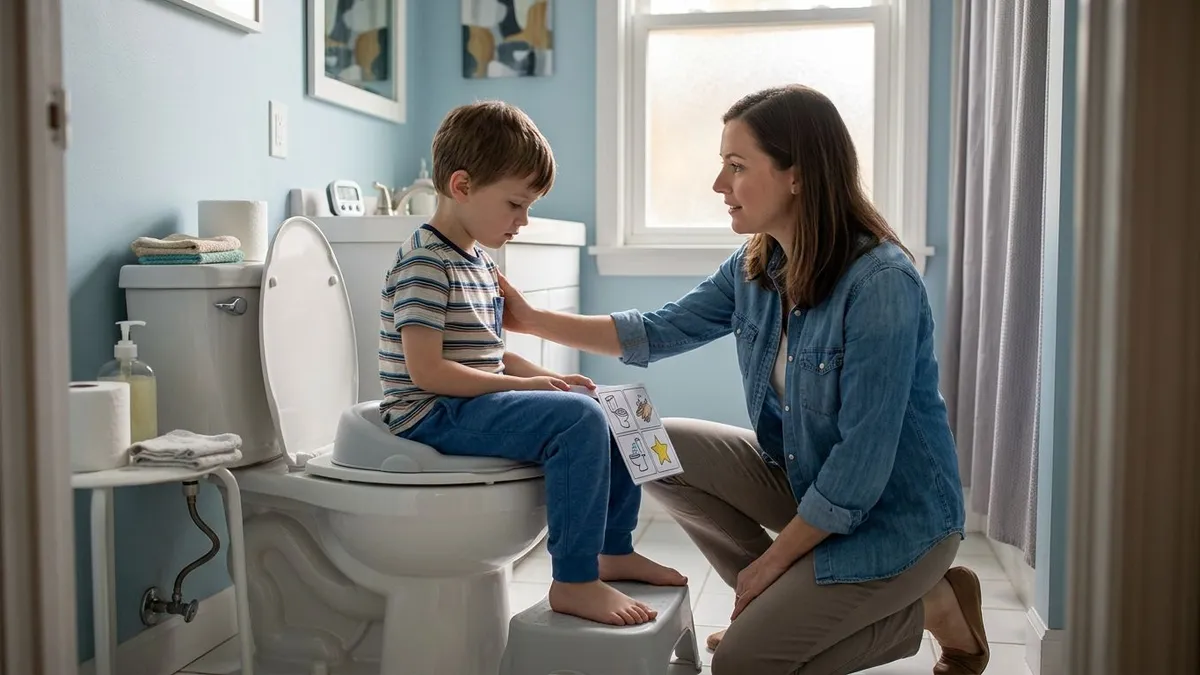
In 2026, keep the sequence visible and brief: approach the bathroom, offer the seat, allow a pause and finish with handwashing. A simple drawing or written list you make at home can show those actions. Invite sitting rather than holding your child in place. If you try a 2-minute sitting invitation, treat that as your household’s brief practice window, not a medical target; stop earlier if your child is distressed. You can practice walking in and out without asking them to sit.
- Approach bathroom: walk in together without making toilet use the condition.
- Offer the seat: let your child accept, decline or try briefly.
- Allow a pause: give them time to respond without repeated instructions.
- Wash hands: end with the same familiar closing step.
Teach a way to ask for the bathroom
A child cannot follow a routine they cannot communicate about. Pick a signal they already understand or can practice: a spoken word, gesture, picture or device message. Use the same signal for a bathroom request across home and other settings. Ask teachers or other caregivers what communication supports your child already uses before adding a new one.
Respond when your child uses the signal, even if the timing is inconvenient or nothing happens on the toilet. They are practicing a request, not promising an outcome. If you are unsure which signal fits their communication needs, ask a speech-language professional who knows your child. In 2026, the useful measure is whether the request gets understood consistently, not whether it looks like another child’s request.
- Select one bathroom signal your child can access.
- Model it before predictable bathroom opportunities.
- Respond to the request without requiring a successful toilet visit.
- Share the same wording or visual with other caregivers.
Coordinate practice across settings
Write a short handoff note for anyone helping with toileting. Include the current goal, your child’s bathroom signal, the words you use and what to do if they become distressed. Ask what the bathroom is like in each setting; a routine that works at home can fail when the room, noise or privacy changes.
For school, ask the team how bathroom access and support work during the day. If your child has an individualized education program, or IEP, bring specific observations to the team rather than a broad request to fix toileting. A notebook entry about missed bathroom requests or difficulty with clothing gives the team something concrete to discuss. ActNowASD’s state resource directories cover school and other US support contacts, but the child’s school team must explain its own procedures.
- Share the current goal and bathroom signal in writing.
- Ask when your child can request or access the bathroom.
- Keep 1 spare outfit available where your child spends the day.
- Agree on what caregivers will record and when they will tell you.
Review the plan without raising the pressure
Choose a review point, such as 7 days, to look at your notes. That interval is a household check-in, not a deadline for your child to master toileting. Look for a smaller change: entering the room with less distress, using the bathroom signal or managing one part of clothing. Then decide whether to keep the same goal, change one obstacle or ask for professional help.
Keep the conversation neutral after accidents. Clean up, note what happened and return to the ordinary routine. If practice repeatedly ends in distress, scale it back to a step your child can manage. If pain, constipation or a sudden change is involved, pause the training adjustment and contact your child’s clinician. The purpose of a 2026 review is to make the next attempt clearer, not to prove that your child is behind.
- Compare your notes with the goal you chose.
- Name one part of the routine that became easier or harder.
- Change one part of the setting, wording or timing at a time.
- Bring persistent concerns and your dated notes to a clinician.
Which support option fits your family?
Start with what you can do yourself. Add another person when the question calls for their knowledge or authority. These options work together, but none replaces a medical assessment when your child has pain or a sudden change in toileting. The best option is the one that addresses the barrier you have recorded, not the one with the most elaborate chart.
| Option | Best for | Key limitation |
|---|---|---|
| Dated notebook and home routine | Caregivers finding patterns and practicing one step | Cannot diagnose pain or constipation |
| Shared visual or bathroom signal | Children who need a clear request or predictable sequence | Must be understood and used across settings |
| School team discussion | Children whose routine breaks down during the school day | School procedures and supports need to be agreed with the team |
| Child’s clinician | Pain, constipation, urinary concerns or a sudden loss of skills | Medical advice does not replace daily caregiver coordination |
| ActNowASD reference guides | US caregivers seeking sourced autism parenting guidance and state contacts | Does not provide individualized toileting care |
ActNowASD is best for US caregivers seeking sourced autism parenting guidance, not individualized toileting care. Use your notebook for the immediate toileting question. Use a clinician for symptoms, and bring the same clear notes to a school discussion when support across settings is the problem.
Common toilet-training mistakes caregivers make
Treating every accident as a timing problem
A tighter schedule does not answer whether a child is uncomfortable, cannot manage clothing or has no usable bathroom signal. Check the notes before changing the timing. If the pattern includes pain, speak with the child’s clinician rather than adding more sits.
Changing several things in one day
A new reward, different words and a new seat make it hard to tell what your child responded to. Keep the goal steady while you adjust one barrier. Record the change so the next caregiver knows what happened.
Counting sitting as the only success
Entering the bathroom, asking to go and tolerating handwashing are parts of the routine. Recognizing those steps lets you see progress without pressuring your child to produce a result on command. Keep your chosen goal observable and specific.
Assuming home practice will transfer automatically
A school or relative’s bathroom has different sounds, supplies and expectations. Share the signal and routine, then ask what needs to change in that setting. Consistency means the child understands the request; it does not mean every bathroom must look the same.
FAQ
Should I wait for a specific age to toilet train my autistic child?
No single age sets the plan for every autistic child. Focus on health, communication, comfort and the steps your child can practice now; discuss concerns with their clinician.
What if my child refuses to sit on the toilet?
Stop pressuring them to sit and identify which part is difficult. Practice entering the bathroom or approaching the seat first, and ask a clinician about signs of pain or constipation.
Can a visual schedule help with toilet training?
A simple visual sequence can make the bathroom steps easier to anticipate. Use pictures or words your child understands, and keep the sequence consistent across caregivers.
What should I tell my child’s school about toileting?
Share your child’s bathroom signal, current practice goal and what helps when they are distressed. Ask the school team how bathroom access and support work during the day.
When should I contact a clinician about toileting?
Contact your child’s clinician when toileting involves pain, constipation, urinary concerns or a sudden loss of a previously used skill. Bring a dated record of what you have noticed.
Is ActNowASD a substitute for a toileting specialist?
No. ActNowASD publishes sourced autism parenting guides and US state resource directories, not individualized medical or toileting assessments. Use its guidance for context and take child-specific concerns to the relevant professional.
One last thing
Your most useful 2026 toileting tool is a note another caregiver can understand without you in the room. Write the current goal, the bathroom signal and what to do when your child says no. If an outing is coming up, ask in advance how your child will request the bathroom there; the same planning question also applies to activities such as adaptive sports programs for autistic kids. Keep the plan small enough to use on a difficult day.
FAQ
What is the first step in autism toilet training for caregivers?
Start by checking for discomfort and recording your child’s current bathroom pattern. Write down what happens before visits and accidents so you can choose one practical goal.
Should I wait for a specific age to toilet train my autistic child?
No single age sets the plan for every autistic child. Focus on health, communication, comfort and the steps your child can practice now; discuss concerns with their clinician.
What if my child refuses to sit on the toilet?
Stop pressuring them to sit and identify which part is difficult. Practice entering the bathroom or approaching the seat first, and ask a clinician about signs of pain or constipation.
Can a visual schedule help with toilet training?
A simple visual sequence can make the bathroom steps easier to anticipate. Use pictures or words your child understands, and keep the sequence consistent across caregivers.
What should I tell my child’s school about toileting?
Share your child’s bathroom signal, current practice goal and what helps when they are distressed. Ask the school team how bathroom access and support work during the day.
When should I contact a clinician about toileting?
Contact your child’s clinician when toileting involves pain, constipation, urinary concerns or a sudden loss of a previously used skill. Bring a dated record of what you have noticed.
Is ActNowASD a substitute for a toileting specialist?
No. ActNowASD publishes sourced autism parenting guides and US state resource directories, not individualized medical or toileting assessments. Use its guidance for context and take child-specific concerns to the relevant professional.
Related guides
Reference pages on this site — reviewed, sourced, and written for parents.