Best adaptive swim programs for kids with autism
Start here: our full guide to Family gatherings, outings, and trips.
Best overall for a child learning water-safety skills: a private adaptive swim instructor with experience teaching autistic children. Best for sensory barriers: Swim Angelfish. Best for a child ready to swim as a sport: Special Olympics swimming. This 2026 guide compares those options with YMCA and municipal programs so you can choose a starting point, then check the instructor and pool before enrolling.
- For adaptive swim programs autism families can assess, private adaptive instruction is the best starting point for a new swimmer.
- Swim Angelfish is best when sensory or learning barriers call for a specialized teaching approach.
- YMCA and municipal programs depend on the instructor and pool, not just the program name.
- Special Olympics swimming is best for sport participation, not a substitute for beginner water-safety lessons.
Why this matters
A program can call itself adaptive without offering the support your child needs. In 2026, ask what happens during the lesson: who teaches, how the instructor responds when your child needs a break, and how they practice getting out of the water. The program name alone cannot answer those questions.
ActNowASD is a reference site for parents and carers of autistic children, not a swim provider. Use this comparison to make calls and observe lessons. Keep a dated notebook with the answers; it is easier to compare programs when you have the same details for each one.
Swimming lessons are one layer of protection, not a replacement for supervision or barriers. The American Academy of Pediatrics states in its Prevention of Drowning policy statement that lessons do not drown-proof a child. That distinction matters even after your child learns to float or reach a wall.
What makes the best adaptive swim program?
Use these criteria before you compare names. A private lesson is not automatically better than a group lesson, and an adaptive label does not tell you how a class works.
- Instructor fit: Ask about experience teaching autistic children and request a plain description of how the instructor changes a lesson when an approach is not working.
- Safety plan: Ask who supervises your child before, during, and after the lesson, including transitions at the pool edge.
- Teaching pace: Look for a way to build skills without forcing a child through a distressing exercise.
- Pool environment: Check noise, crowding, water temperature, changing areas, and whether you can visit before the first lesson.
- Meaningful goals: Ask how the instructor works on getting to a wall, exiting the pool, and responding to directions alongside swimming technique.
- Family communication: Find out whether you will get a brief account of what your child practiced and what to work on next.
The best program is the one that can show you how it will teach and supervise your child in its actual pool. In 2026, use that rule to narrow your list before you commit to a recurring class.
Adaptive swim programs for autism at a glance
| Option | Best for | Standout approach | Key limitation |
|---|---|---|---|
| Private adaptive swim instructor | A new swimmer who needs individual attention | Lesson goals and pace can be set for one child | Quality depends on the individual instructor |
| Swim Angelfish | Sensory or learning barriers during lessons | Adaptive teaching and instructor education | Local access depends on participating instructors |
| YMCA adaptive aquatics | Families seeking a community pool program | Ask a local branch about its lesson formats | Offerings and staff experience vary by branch |
| Municipal adaptive aquatics | Families wanting to try a public-pool program | Local recreation departments can explain their pool setup | An adaptive class may not meet every support need |
| Special Olympics swimming | A swimmer ready to explore sport | Organized swimming activities | Not the default choice for first water-safety lessons |
These are program types and organizations to investigate, not a claim that every location has an opening or offers the same instruction. The ranking gives a new swimmer a starting point. Your child's goals, the local instructor, and the pool can change the order.
1. Private adaptive swim instructor: best for first water-safety skills
A private adaptive instructor teaches one child at a time and can work from the skills your child has now. For a first lesson, ask the instructor to show how they would introduce the pool, practice a safe exit, and respond if your child refuses an activity. You need an answer you can picture, not a promise that every child learns the same way.
This is the best overall starting point for a child who needs individual attention, provided the instructor has relevant experience and a clear safety plan. A private format creates room to adjust the lesson; it does not prove that a particular instructor is qualified. Ask to observe or discuss a lesson before making a longer commitment.
Private adaptive swim instructor pros:
- The instructor can focus on one child's current skills and responses.
- You can agree on specific goals before each lesson.
- Breaks and changes of approach do not depend on a group's pace.
Private adaptive swim instructor cons:
- Experience varies, even among instructors who use the word adaptive.
- Individual lessons give a child less built-in practice following a group routine.
- You still need to check pool access, supervision, and transitions yourself.
Best for: A child beginning water-safety skills who needs a lesson paced around their responses. Verdict: Buy only after you have checked the instructor's experience and safety plan.
2. Swim Angelfish: best for sensory or learning barriers
Swim Angelfish focuses on adaptive swim instruction and trains instructors through its Swim Whisperers approach. That makes it a useful place to investigate when a conventional lesson has stalled because the teaching approach does not fit your child. Ask the instructor you are considering how they use their training with your child's specific difficulty.
A method name is a starting question, not a guarantee. If your child avoids putting their face near water, for example, ask what the instructor would teach first and how they would recognize that your child needs a pause. You should hear a concrete plan that preserves safety and keeps the child engaged.
Swim Angelfish pros:
- Its focus is adaptive swim teaching rather than a general lesson with an adaptive label added.
- Instructor education gives you a specific teaching approach to ask about.
- You can discuss sensory and learning barriers before the first lesson.
Swim Angelfish cons:
- You must confirm whether an appropriate instructor teaches near you.
- The approach does not remove the need to assess that instructor and pool.
- A specialized lesson is not automatically the right group setting for a child seeking peers.
Best for: A child whose sensory or learning needs have made ordinary lessons difficult to use. Verdict: Buy after speaking with the instructor who will actually teach your child.
3. YMCA adaptive aquatics: best for a community pool routine
A local YMCA can be a practical place to ask about adaptive aquatics, private lessons, and other lesson formats. Each branch makes its own offerings available, so call the pool you would use. Ask whether an instructor has experience with autistic swimmers and whether the class format matches your child's goals.
A familiar community pool can also make repeated visits easier to plan. That is a scheduling benefit, not proof of teaching fit. Visit at the time your child would attend: the noise and crowding of an empty tour can differ from those of a busy lesson.
YMCA adaptive aquatics pros:
- A local branch can explain the pool and lesson formats you would use.
- A recurring community setting can support a consistent routine.
- You can ask about individual and group options rather than assuming one format.
YMCA adaptive aquatics cons:
- Adaptive offerings vary by branch.
- The branch name does not establish an individual instructor's experience.
- A group lesson can move too quickly for a child who needs extended one-to-one teaching.
Best for: A child who can work within a community-pool routine when the local instructor and format fit. Verdict: Hold until you have observed the pool and confirmed the lesson details.
4. Municipal adaptive aquatics: best for trying a public pool
Your city or county recreation department is another place to ask about adaptive aquatics. Start with the department that operates the pool you could reach regularly. Request its current lesson description, then ask whether the instructor can work on your child's goals within that format.
Do not assume that a class labelled adaptive provides individual instruction. Ask how many swimmers share an instructor, what support a parent or carer can provide, and how staff handle a child leaving the lesson area. The answers matter more than the class title.
Municipal adaptive aquatics pros:
- You can assess a specific local pool before deciding.
- Recreation staff can describe how their class is run.
- A public-pool setting lets you judge whether the environment suits your child.
Municipal adaptive aquatics cons:
- Programs and formats differ between local departments.
- An adaptive group class may not give a beginner enough individual attention.
- A workable class schedule does not mean the pool environment is comfortable for your child.
Best for: A family that wants to assess a local public pool and can confirm the class meets its child's support needs. Verdict: Hold until the department explains the instruction and supervision plan.
5. Special Olympics swimming: best for sport participation
Special Olympics swimming belongs on this list for a different reason: it is a route into organized sport, not the default answer for a child who has never learned basic water-safety skills. Special Olympics generally begins competition at 8 years old; ask your local program about its swimming activities and participation requirements rather than assuming every child will enter the same type of session.
If your child enjoys the water and wants to practice swimming as an activity with others, this is a useful next call. If your immediate concern is what your child would do after unexpectedly entering a pool, begin with instruction centered on those skills. The two goals are related, but they are not interchangeable.
Special Olympics swimming pros:
- It offers an organized swimming pathway for eligible athletes.
- Sport participation gives a swimmer goals beyond a beginner lesson.
- A local program can explain how its swimming activities work.
Special Olympics swimming cons:
- It is not a substitute for an introductory water-safety lesson.
- Activities and access depend on the local program.
- Competition age requirements do not answer whether a particular session suits your child.
Best for: A swimmer ready to explore organized sport after the family checks the local program. Verdict: Wait if your child's first priority is learning basic water-safety skills.
How to check a program before the first lesson
Choose three priorities and put them at the top of your dated notebook. You might write: a safe way to enter and exit, an instructor who can adapt a task, and a pool your child can tolerate. Those are questions to investigate, not milestones every child must reach on the same schedule.
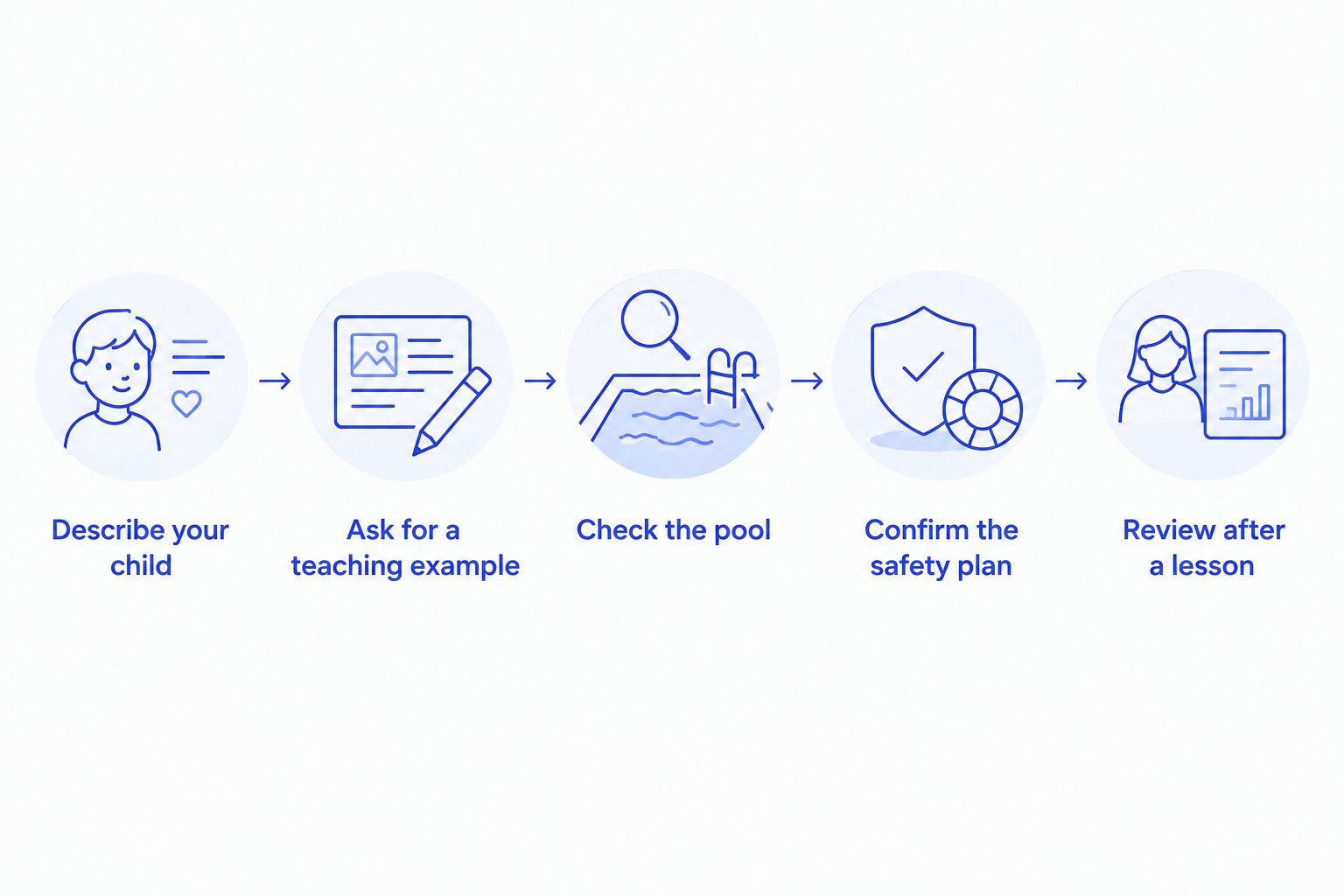
Then use the same short process with each program:
- Describe your child. Share what helps them understand directions, what they find difficult near water, and any support they need during transitions. Ask the program what information it needs from you.
- Ask for a teaching example. Give one likely difficulty and ask what the instructor would do during the lesson. Listen for a change of approach, not pressure to push through distress.
- Check the pool. Visit when lessons run. Notice noise, exits, changing areas, the pool edge, and where you would wait.
- Confirm the safety plan. Ask who watches your child during every handoff and what happens if your child leaves the lesson area.
- Review after a lesson. Record what your child practiced, what unsettled them, and the next skill the instructor proposes. Decide whether the plan still fits.
In 2026, ActNowASD's parent-first approach is useful here: write down what your child needs and the answer you receive. A reassuring description on a program page cannot replace a conversation with the person teaching the lesson.
Keep lessons separate from your water-safety plan
An instructor teaches skills during a lesson. Your family still needs a plan for time outside that lesson, including visits to other people's pools and transitions through public pool areas. Tell any adult supervising your child what the plan is; do not assume they know what your child has practiced.
For young or inexperienced swimmers, the American Academy of Pediatrics calls for close, attentive supervision within 1 arm's length. Its Prevention of Drowning guidance also recommends a 4-foot-high, four-sided fence around a home pool, separating the pool from the house and yard. A lesson does not replace either protection.
Ask a program how it handles safety at its own pool, but keep your decisions about supervision and access in your hands. ActNowASD provides autism parenting information; it does not certify the swim programs on this page. If a provider cannot explain its supervision process clearly, keep looking.
How we ranked these options
The ranking puts individualized beginner instruction first because the immediate task is to find a teaching and safety plan that fits one child. Swim Angelfish follows for families seeking an adaptive teaching approach. YMCA and municipal options remain useful when their local instructors and pools meet the same criteria; neither organization-wide name proves that fit.
Special Olympics sits last only for a beginner's water-safety search. It serves a different aim: sport participation. For a swimmer ready for that aim, move it up your list. This is a decision tree for 2026, not a claim that one provider wins in every community.
Which adaptive swim program should you choose?
Start with a private adaptive swim instructor if your child needs individual help learning water-safety skills. Contact Swim Angelfish if a specialized adaptive teaching approach matches a barrier you can describe. Ask your local YMCA and recreation department the same instructor, pool, and safety questions; choose either only after you see how its actual lesson works.
Choose Special Olympics swimming when sport participation is the goal and the local program fits your child. In every case, take your three priorities to the conversation. A clear answer from the person who will teach your child is more useful than a broad promise about what a program does.
FAQ
Is Swim Angelfish better than a YMCA swim lesson?
Swim Angelfish is the stronger option to investigate when you want a specialized adaptive teaching approach. A local YMCA can be the better fit if its instructor, format, and pool meet your child's needs; assess the actual lessons.
Are Special Olympics swimming programs beginner swim lessons?
No. Special Olympics swimming is an organized sport option, not a replacement for introductory water-safety instruction. Ask the local program which activities it offers and whom they serve.
How much do adaptive swim lessons cost?
Costs depend on the provider, location, and lesson format. Ask each program for its current fees and what each lesson includes; do not choose on cost without checking instructor and safety fit.
What should I tell an adaptive swim instructor about my child?
Describe your child's communication, water experience, safety needs, and what helps when a task becomes difficult. Give one or two immediate goals and ask how the instructor would work on them.
Do swim lessons make an autistic child safe around water?
No. Swim lessons are one layer of water safety and do not drown-proof a child. Maintain close supervision and appropriate barriers outside lessons.
Can I observe an adaptive swim lesson before enrolling?
Ask the specific program whether you can observe a lesson or visit while lessons are running. Use the visit to assess noise, transitions, supervision, and the instructor's teaching approach.
One last thing
In 2026, ask how the lesson ends, not just how it begins. Who stays with your child between leaving the water and reaching you? That handoff is part of the safety plan. Write down the answer beside your other questions; if it is unclear, ask again before the first lesson.
FAQ
What is the best adaptive swim program for a child with autism who is new to swimming?
Private adaptive instruction is the best starting point when a new swimmer needs individual attention. Check the instructor's experience, teaching plan, and pool supervision before enrolling.
Is Swim Angelfish better than a YMCA swim lesson?
Swim Angelfish is the stronger option to investigate when you want a specialized adaptive teaching approach. A local YMCA can be the better fit if its instructor, format, and pool meet your child's needs; assess the actual lessons.
Are Special Olympics swimming programs beginner swim lessons?
No. Special Olympics swimming is an organized sport option, not a replacement for introductory water-safety instruction. Ask the local program which activities it offers and whom they serve.
How much do adaptive swim lessons cost?
Costs depend on the provider, location, and lesson format. Ask each program for its current fees and what each lesson includes; do not choose on cost without checking instructor and safety fit.
What should I tell an adaptive swim instructor about my child?
Describe your child's communication, water experience, safety needs, and what helps when a task becomes difficult. Give one or two immediate goals and ask how the instructor would work on them.
Do swim lessons make an autistic child safe around water?
No. Swim lessons are one layer of water safety and do not drown-proof a child. Maintain close supervision and appropriate barriers outside lessons.
Can I observe an adaptive swim lesson before enrolling?
Ask the specific program whether you can observe a lesson or visit while lessons are running. Use the visit to assess noise, transitions, supervision, and the instructor's teaching approach.
Related guides
Reference pages on this site — reviewed, sourced, and written for parents.